Case study · our own product · live
Gold-O-Matic
Eight forces move the price of gold. We built a free site that weighs all eight on one brass gauge, in plain English. Then we tested the gauge in public and published the results it did not like.
Live at gold-o-matic.comLaunched August 10, 20268 forces, 1 gaugeNot a price forecast
May to August 2026
The gauge: making eight forces readable
1.1 · The problemThe news shows one force at a time
Gold coverage tells you the price. On a good day it tells you one reason. But the price is the result of several things pulling at once, some up and some down, and a reader with the headlines in front of them still can't see the whole picture.
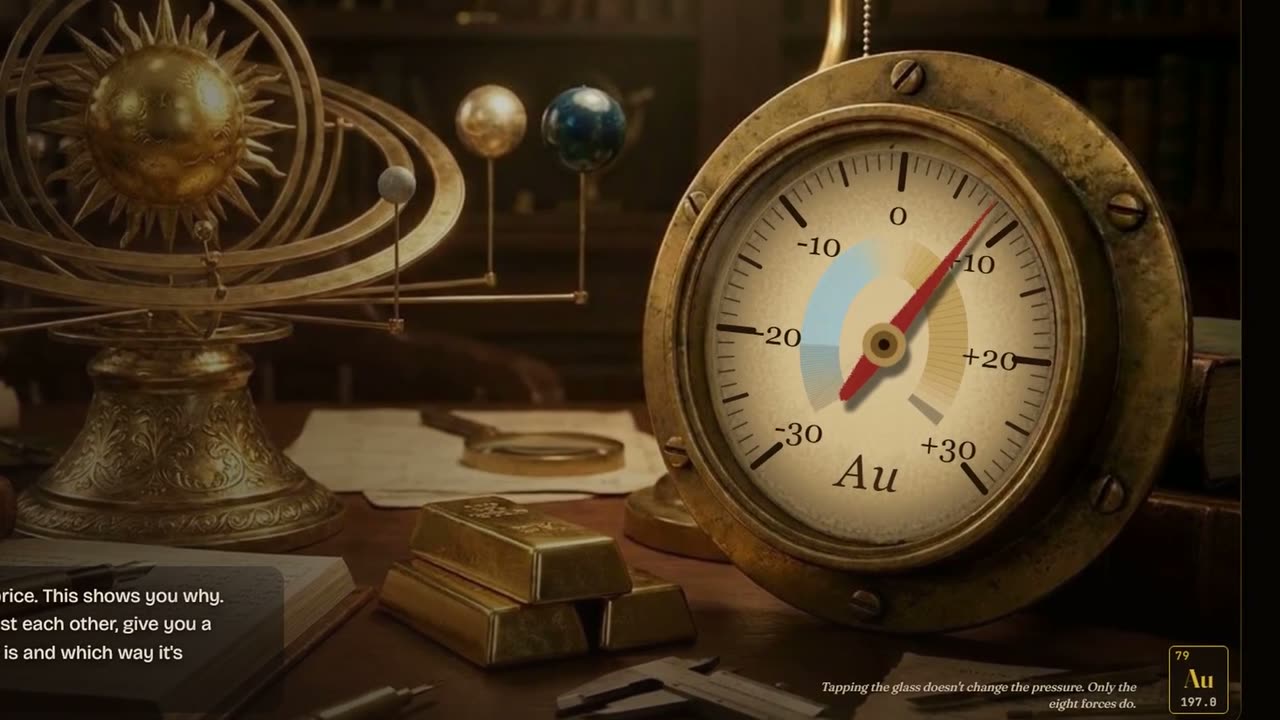
Gold-O-Matic puts all eight forces on one screen, weighs them against each other, and shows the result as a needle on a pressure gauge. Next to the needle is a short note, in ordinary words, on why it reads what it reads this week.
- 1Central banks
- 2Geopolitics and haven
- 3Real rates and the Fed
- 4Inflation
- 5US dollar
- 6ETF flows
- 7Physical demand
- 8Mine supply
1.2 · The look and the voiceA watchmaker's desk, a friend at dinner
Two decisions were made early and never reopened. The look is a watchmaker's desk: brass, ivory, lamplight, an orrery in the corner. The voice is a smart friend at dinner: informed, relaxed, never breathless. The tagline carries both: "Eight forces. One gauge. No PhD required."
The desk and its gauge are a still picture, made with AI. The dial on top of the gauge is drawn by the site, so the needle moves with the data. One rule sits above the design: the pressure is always worked out from real-world numbers. Nothing on the page may suggest a person sets it.
1.3 · June 24 to August 22From one file to a living site
The project brief of May 29 describes a single file with hand-updated numbers and no live feeds. The first build instruction went to the site builder on June 24. The site launched on August 10, just under seven weeks later, and was feature-complete on August 22.
By then it had grown three things the brief never promised. The data refreshes itself every day from public sources. Every panel can be read aloud, in a choice of two voices, with a guided tour for first-time visitors. And there is a bench to try it yourself: move a slider, such as real interest rates, and watch the needle swing.
Lesson
A site that fetches fresh data can look alive while its code is frozen. For four days in September an approved text fix sat unpublished, and nobody noticed, because the prices kept moving. We now check the exact words we changed on the live address, not whether "the site is updating."What went wrong
In August the last step of the daily data job failed for eight days. Every earlier step reported success, so the site showed week-old figures under a fresh-looking time stamp. We found it, fixed it, and now test the thing a visitor receives, not the job's own report.August to November 2026
The scorecard: testing it in public
2.1 · The charterHonesty over polish
A gauge about money invites one question: does it work? Most sites answer with a flattering chart. Gold-O-Matic has a written rule instead.
Never make a change that quietly makes the model look better.Gold-O-Matic charter, in force since August 12, 2026
In practice the scoring is frozen. No threshold or weight changes without a specific, approved number and a dated note on the site saying what changed. A styling update is not allowed to move a single figure as a side effect.
2.2 · The backtestThe result that came out backwards
A backtest replays history to see whether a method would have helped. When the four forces with the longest records were replayed from 2006, the gauge's reading and gold's return over the following year moved in opposite directions more often than not (a rank correlation of −0.57). The site publishes that number on its Track record page and warns readers not to read the gauge backwards either.
2.3 · November 9The test with the hindsight removed
The backtest had a flaw of its own: its thresholds were set in 2026, after the history was known. So the model was rebuilt quarter by quarter, using only the figures that existed on each date.
The rules were written down first. The method, the pass mark, and the sentence that would be published for each possible outcome were approved before the test ran. It ran once.
Across 43 forecasts from 2015 to 2025 the result was positive (+0.45), but it cleared only one of the two checks the rules required. The verdict published on the site is the one the rules dictate: "indistinguishable from zero." When the gauge did lean one way it was right 11 times in 17, which is no better than always saying "up" in years when gold mostly rose.
| Test | Result | What the site says |
|---|---|---|
| Four forces, replayed from 2006 | −0.57 | Strongly negative. Don't read the gauge backwards either. |
| Eight forces, no hindsight, next year | +0.45 | Indistinguishable from zero (one of two required checks passed). |
| Direction calls, no hindsight | 11 of 17 | No better than always saying "up." |
| Real-rate rule alone, 2006 onward | −0.70 | Clearly negative. |
The sentence we had to change
One sentence written before the test assumed the earlier result came from hindsight. The data said otherwise. Publishing a line the numbers contradict would break the charter, so it was replaced, and the replacement is recorded as a dated deviation.Lesson
Decide what counts as a pass before you look. A near miss is still a miss, and saying so costs less than explaining later why the bar moved.2.4 · November 9Measured, not assumed
The same habit applies to the plain mechanics of the site. A build once reported that every button was large enough for a thumb. We tested it with a fingertip-sized probe on the live page instead of trusting the report: 141 of 144 controls passed, and the last three were fixed that day. The fonts now load from the site itself, which ended an error that had appeared on every page load since August.
November 9 to 10, 2026
The film: 47 seconds, no stand-ins
3.1 · The footage ruleThe live gauge is the star
A generated picture of a dial can't show the site's real needle. So every screen in the film was recorded from the real site, at 60 frames a second: the opening push-in to the gauge, the eight forces in orbit, the track record, and the slider that swings the needle when real rates move from 2.65% to −1.00%.
The narration follows the same rule as the site's guided tour. It may set the scene and make the argument. It may not state a fact a viewer would have to check, so the film does not go stale when the reading moves.
3.2 · Twelve cutsNumbers first, then eyes
The film went through twelve cuts in two days. The sound was measured, not judged by ear alone: the final master sits at the loudness streaming services expect, and plays correctly on a single phone speaker. The wide version came first; the phone version was built from the same footage and the same sound.
What went wrong
Cut 11 measured as smooth and was still wrong: the opening shot sat in the top-left corner of the frame with gray around it. The recording tool does not enlarge a page to fill a bigger frame.Lesson
Smoothness numbers don't prove framing. Every shot now gets looked at as a still before a cut goes out.Business · how it was madeThe working arrangement
People. Paul Berg, Tech Doctor at Technology On Call: concept, editorial judgment, every approval.
The AI partner. Claude planned the work, wrote each build instruction, and checked the results. A separate AI site builder made the code changes. Nearly 500 build instructions went through it between June 24 and October 6.
The site. Pages are assembled on the server, so a search engine or an AI assistant reads the same words a person does. A small program refreshes the figures every day from public sources: the Federal Reserve's data service, a published geopolitical risk index, futures positioning reports and the gold price.
Voice and film. Narration is AI voice, with each recording tied to the exact text it reads, so a changed sentence can never play stale audio. The film's music is AI-generated. Both are disclosed here because we would want to know.
Business · scaleBy the numbers
Counts as of November 9 and 10, 2026, from the project's own records and the live site.
Business · carry forwardLessons we now apply to client work
Test the thing a visitor receives. A job that reports success, a builder that says "done" and a site that seems lively are three different facts from "the change is live."
Read the page before writing for it. We once drafted three "new" findings the site already published. Running them would have counted one result twice.
Ask what a visitor loses if it is never fixed. An afternoon went into an error no visitor could see. We wrote it down, left it, and fixed it later inside work that was already touching the fonts.
Write the rules before the test. It is the only way a near miss stays a miss.
Business · trustWhat this is not
Gold-O-Matic is not a price forecast, not a trading signal and not financial advice. Those words are on the site itself. Its own tests do not show that it predicts the gold price, and this page does not claim it does.
What the project does show is how we work: a hard subject made readable, a build that looks after itself, and a scorecard kept in public, including the lines we would rather not have had to write.
See it for yourself
The Track record and Methodology sections hold everything quoted above.
Open gold-o-matic.com Talk to the Tech Doctor about a project